Bitcoin is the real form of money due to open source code, fixed supply, and decentralization that altcoins have not replicated.
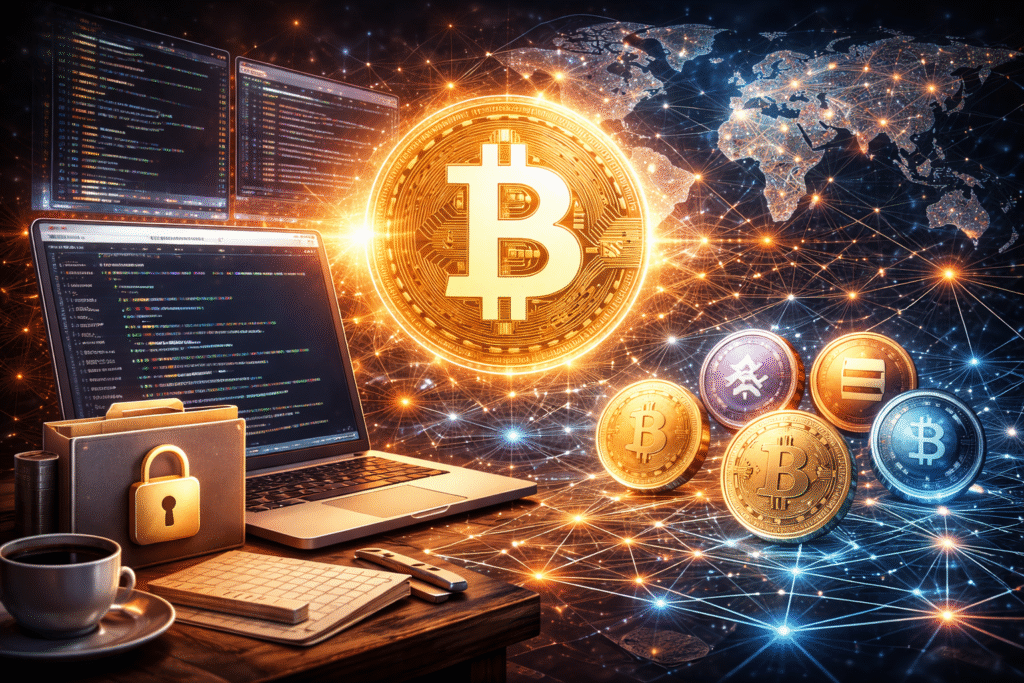
Bitcoin Is the Real Form of Money Because It Is Fully Open Source
One of the most extraordinary things about Bitcoin is that its entire source code is open.
Anyone can download it.
Inspect it.
Review it line by line.
The Bitcoin Core repository is publicly available on GitHub, where developers and researchers continuously audit and improve it.
https://github.com/bitcoin/bitcoin
Given that transparency, an obvious question arises.
If Bitcoin’s code is open source and visible to the world, why has no altcoin successfully created a superior form of money?
This is where the conversation becomes deeper than technology.
Bitcoin Is the Real Form of Money Because Code Alone Is Not Enough
Many altcoins claim to be faster.
Cheaper.
More scalable.
More innovative.
But money is not just software. It is a network of trust.
Bitcoin’s strength does not come from hidden algorithms. It comes from decentralization, predictable monetary policy, and over a decade of uninterrupted operation.
The 21 million supply cap cannot be changed unilaterally. No foundation controls issuance, No CEO governs policy. No marketing team decides upgrades.
Most altcoins, by contrast, are created by identifiable teams, often with pre mined allocations, governance councils, or centralized decision making processes.
Technology can be copied.
Credible neutrality cannot.
This is why Bitcoin is the real form of money rather than just another crypto project.
Bitcoin Is the Real Form of Money Because It Prioritizes Monetary Policy
When evaluating money, the core questions are:
Can supply be altered easily?
Can the transactions be censored?
Or the governance be influenced by insiders?
Bitcoin’s monetary policy is simple and transparent. Block rewards decline on a fixed schedule. Supply issuance is publicly auditable. Nodes verify every rule independently.
Altcoins frequently modify token supply, governance models, or inflation rates through foundation votes or developer decisions.
That flexibility may serve experimentation.
But monetary systems demand rigidity.
This distinction is critical.
Altcoins as Technological Experiments
Altcoins are not inherently useless. Many are technological experiments exploring smart contracts, scalability models, or different consensus mechanisms.
But experimentation and money are not the same category.
Money requires long term stability, decentralization, and resistance to manipulation. Experimentation often requires flexibility and iteration.
When projects are marketed as “the next Bitcoin,” it is often because narrative drives attention. But narrative does not create monetary credibility.
Over time, Bitcoin has accumulated hash power, global nodes, institutional scrutiny, and regulatory recognition. These layers create network effects that are difficult to replicate.
Why Open Source Did Not Create a “Better Bitcoin”
If Bitcoin’s code is public, theoretically anyone could copy it and improve it.
Many have tried.
But copying code does not copy decentralization. It does not copy distribution history. It does not copy the absence of a central issuer.
Bitcoin launched without venture capital allocation, without insider token distribution, and without a corporate entity.
That origin story matters.
Money is not only about features. It is about fairness and credibility.
Understanding these foundations is essential. The Bitcoin Essential Course by Azad Money explains why decentralization, fixed supply, and incentive structure matter more than technical upgrades.
There Is No Second Best in Monetary Networks
In technology markets, there can be multiple winners.
In monetary networks, dominance tends to concentrate.
History shows that reserve currencies and monetary standards consolidate around the most trusted system. Competition may exist, but fragmentation weakens monetary function.
When people say “Bitcoin is the real form of money,” it reflects the belief that credible neutrality, fixed supply, and decentralization are non negotiable properties.
Other projects may innovate.
But monetary trust accumulates slowly and is rarely replaced once established.
Final Thought
The question is not whether altcoins can build new features.
The question is whether they can replicate decentralized credibility at scale without centralized control.
So far, no project has matched Bitcoin’s combination of:
Fixed monetary policy
Open source transparency
Decentralized governance
Global distribution
Technology evolves quickly.
Monetary trust evolves slowly.
And that is why many conclude that Bitcoin is the real form of money.
What is your view?
Can technological upgrades replace monetary neutrality, or does credibility outweigh features?
Let’s continue the discussion in the comments.