Bitcoin vs Stablecoins debate is evolving as billions move under sanctions. Learn why control, neutrality, and resilience matter now.
Why Bitcoin vs Stablecoins Matters Now
While everyone’s eyes were on Bitcoin, something else was quietly moving in the background.
Recent data shows nearly $3 billion in crypto linked flows tied to sanctioned activity, yet only about $600 million was frozen. That means roughly $2.4 billion still moved successfully, despite heavy scrutiny.
This changes the conversation. The question is no longer whether digital currencies can be controlled. Instead, it becomes about how different types of digital assets behave under pressure and what role they play in global finance.
Bitcoin vs Stablecoins in Real World Use
At first glance, many assume Bitcoin drives most of this activity.
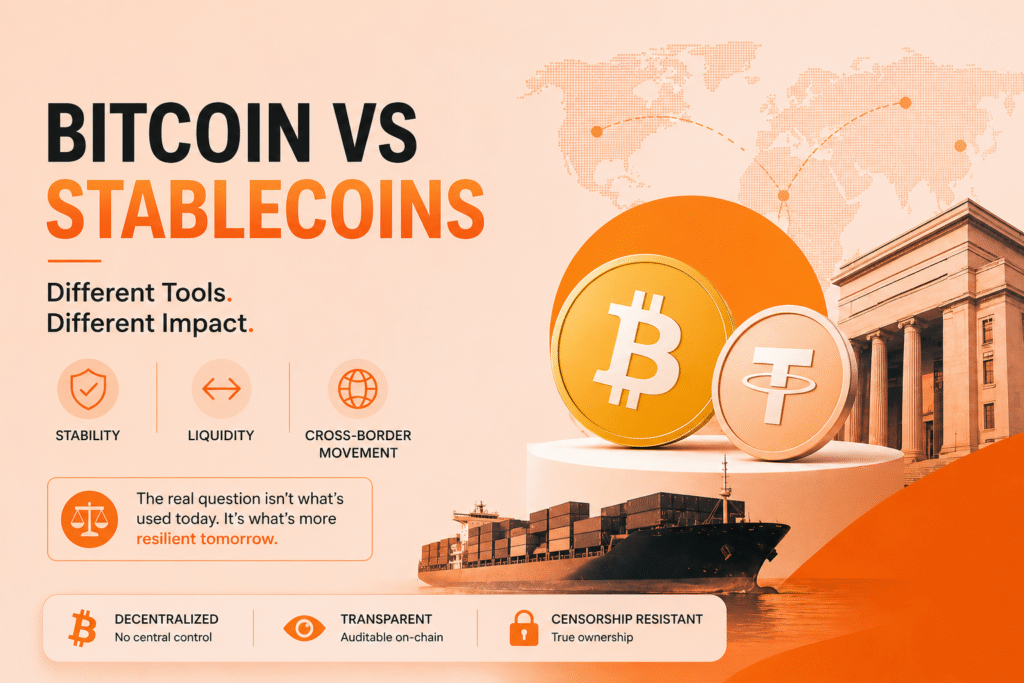
However, the reality looks different. Stablecoins like USDT dominate these flows. The reason is simple. They combine three key features that make them highly effective in such environments.
• Price stability
• High liquidity
• Easy cross border movement
In many ways, they function like digital dollars. They move quickly, settle efficiently, and avoid many traditional barriers. That makes them extremely useful when speed and access matter.
According to insights highlighted in this analysis and further covered by Cointelegraph, stablecoins are currently the preferred tool in these scenarios.
The Hidden Risk in Bitcoin vs Stablecoins
Despite their efficiency, stablecoins come with a structural tradeoff.
They are centralized.
That means they are issued, controlled, and can be frozen by specific entities. We have already seen billions in transactions being blocked when required. This creates a system that is fast and convenient, but not fully independent.
This is where Bitcoin enters the conversation from a completely different angle.
Bitcoin does not have an issuer. No central authority controls it. Once a transaction is confirmed, it cannot be reversed or frozen. Every transaction is visible on chain, making the system transparent and auditable.
This difference becomes critical in high scrutiny environments. A system that cannot be selectively controlled offers a different kind of reliability over time.
Bitcoin vs Stablecoins and Future Systems
Right now, stablecoins dominate because they are practical.
They move quickly and behave like familiar currency. However, their reliance on centralized control creates long term limitations. Convenience today does not always translate into resilience tomorrow.
Bitcoin, on the other hand, sacrifices some convenience for stronger fundamentals. Neutrality, censorship resistance, and true ownership are built into its design. These properties become more valuable as global systems face increasing pressure.
If you want to understand how Bitcoin fits into this evolving financial structure, the Bitcoin Essentials course explains the system and its long term role clearly.
Final Perspective
This is not just about what is being used today.
It is about what systems are built to last.
Stablecoins may dominate in the short term because they are efficient. But Bitcoin represents a different model entirely. One that focuses on independence, transparency, and resistance to control.
So the real question becomes simple.
Which system matters more in the long run?
Need help building your Bitcoin strategy?
Message directly on WhatsApp.
+971 56 739 9526
Curious to hear your thoughts.
Should Bitcoin be treated as a strategic asset, or regulated like every other financial instrument?