Bitcoin portability in crisis offers mobility, liquidity, and self custody when physical assets like land or gold become difficult to move.
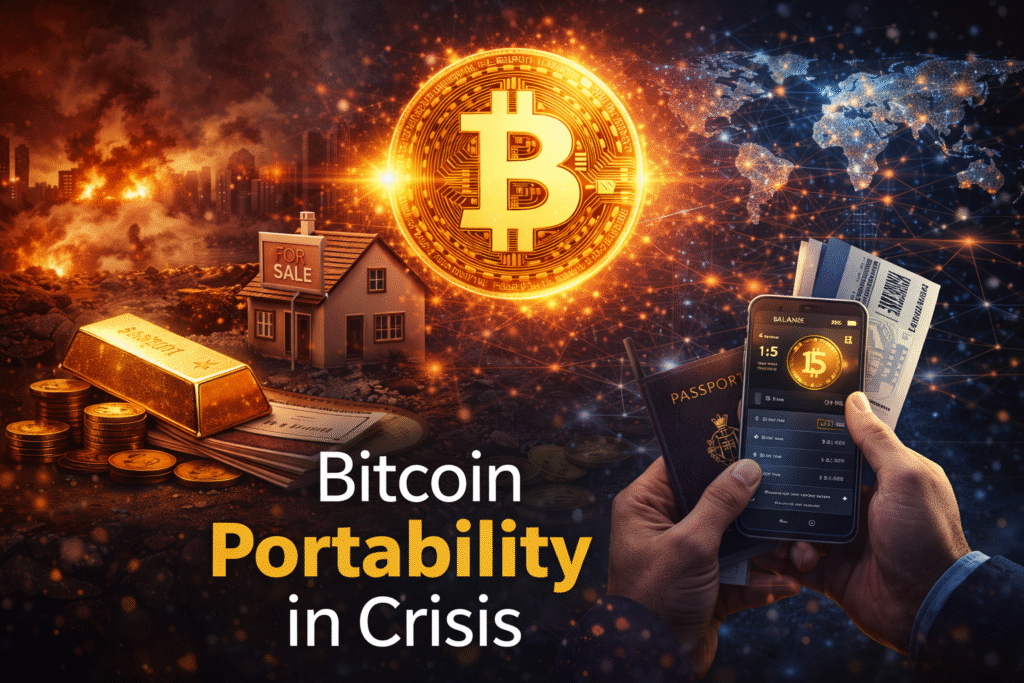
Bitcoin Portability in Crisis Changes the Conversation
A common argument says, “Only what you physically hold is truly yours.”
Land is real.
Gold is tangible.
Digital money feels abstract.
But Bitcoin portability in crisis forces us to examine a different question:
What happens when you cannot stay where your assets are?
Consider people living in war zones or regions facing economic collapse. In modern history, citizens in countries such as Syria, Ukraine, Lebanon, Venezuela, and others have faced sudden displacement, currency instability, or capital controls.
When conflict or crisis erupts, the issue is not theoretical wealth.
It is mobility.
Land Is Stable Until You Cannot Access It
Real estate is often considered the safest investment.
But land is immovable.
If your country faces war or political breakdown and you need to leave urgently, how do you liquidate property in a collapsing market?
During conflicts, property transactions freeze. Buyers disappear. Legal systems slow down. Capital controls tighten.
Owning land does not help if you cannot access its value when you need it most.
This is not a criticism of real estate. It is a reminder that liquidity and portability matter in extreme scenarios.
Gold Is Valuable but Difficult to Move
Gold has served as money for thousands of years.
It has no counterparty risk. It is physically scarce.
But gold has constraints:
• Transporting significant quantities across borders can raise legal and security concerns
• Airport customs regulations often require declarations for high value metals
• Verifying authenticity requires specialized tools
A normal individual cannot easily test purity without professional equipment.
In crisis situations, these frictions matter.
Bitcoin Portability in Crisis Offers a Different Model
This is where Bitcoin portability in crisis becomes relevant.
Bitcoin is not physical. It exists on a decentralized network secured globally.
Ownership is controlled by private keys. With proper security practices, access can be restored anywhere in the world with an internet connection.
Liquidity operates 24 hours a day across exchanges and peer to peer markets globally.
Unlike physical assets, Bitcoin does not require transportation. It requires access.
It is important to note that Bitcoin is volatile and subject to regulatory environments in different countries. It is not risk free.
But in terms of portability, it introduces a capability that traditional assets cannot match.
Verification Without Physical Inspection
Gold must be tested.
Land must be legally transferred.
Bank balances depend on institutions remaining operational.
Bitcoin transactions are verified by a global network of nodes following transparent consensus rules. Anyone can verify supply and transactions using open source software.
This is not ideology. It is architecture.
The Bitcoin Core codebase is publicly auditable by anyone.
https://github.com/bitcoin/bitcoin
Verification does not require trusting a vault or a government registry. It requires running software that enforces the rules.
Understanding Before Adopting
This is not an argument to sell everything and buy Bitcoin.
It is an invitation to understand the difference.
Financial systems are designed for stability during stable times.
But stress tests reveal hidden limitations.
If you want a structured explanation of how self custody works, how private keys function, and how Bitcoin’s monetary policy differs from traditional systems, the Bitcoin Essential Course by Azad Money breaks it down clearly and responsibly.
Understanding reduces confusion.
Final Perspective
The real question is not whether land or gold are valuable.
They are.
The real question is what happens when geography itself becomes a risk.
In a world where political uncertainty, conflict, and capital controls exist, mobility becomes a form of financial security.
Bitcoin portability in crisis does not guarantee safety.
But it offers a level of flexibility that physical assets cannot provide.
At minimum, it deserves understanding.
Before dismissing digital money, ask:
If you had to leave everything behind tomorrow, what could you realistically carry with you?
Let’s continue the discussion in the comments.