War and money printing often reshape financial markets. Learn how inflation cycles can influence Bitcoin’s long term value.
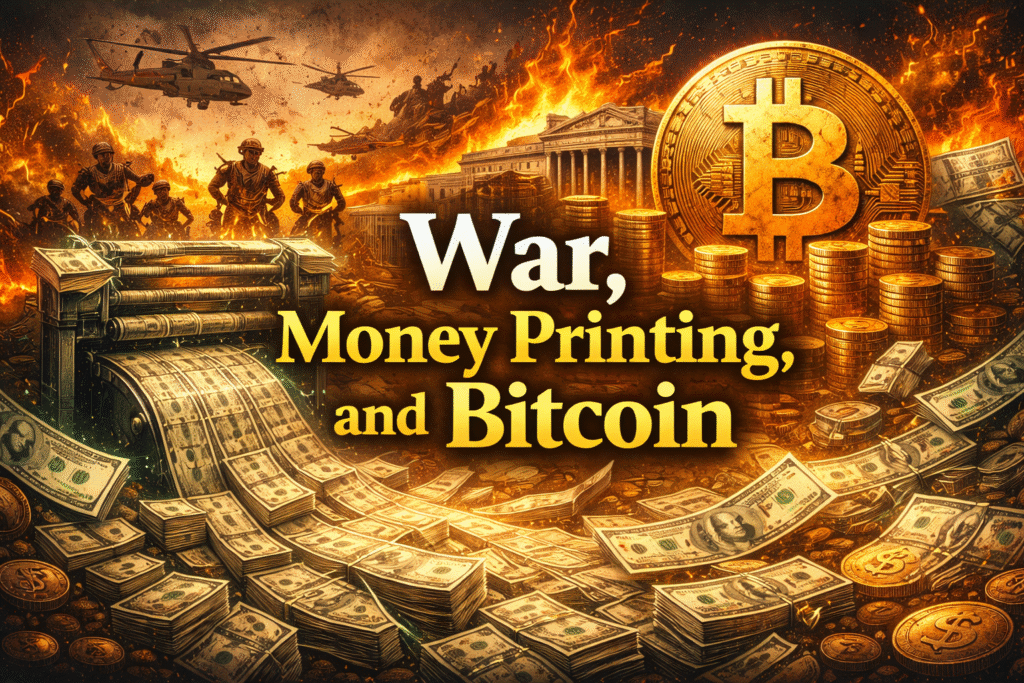
Why Wars Change Financial Systems
Every major war in history has forced governments to spend enormous amounts of money. Military operations, supply chains, reconstruction efforts, and economic stimulus all require capital that most countries simply do not have sitting idle.
Because of this, governments often rely on expanding the money supply to finance large-scale conflicts. Central banks increase liquidity through borrowing, bond issuance, and monetary expansion. Over time, this process can weaken the purchasing power of fiat currencies and create inflationary pressure across global markets.
Scarce Assets During Monetary Expansion
When money supply increases rapidly, investors usually begin looking for assets that cannot be easily inflated. Historically, commodities like gold have served this role because their supply cannot be expanded quickly.
Bitcoin introduces a similar concept in digital form. Its supply is permanently capped at 21 million coins, and that limit cannot be changed by governments, corporations, or central banks. Because of this fixed supply, Bitcoin is often described as a scarce digital asset that responds differently to monetary expansion.
Economic history shows that during periods of aggressive money printing, scarce assets often experience significant repricing. This does not always happen instantly, but over time markets adjust as liquidity moves through the system.
What History Suggests About Bitcoin
While Bitcoin is still relatively young compared to traditional assets, its behavior often reflects global liquidity trends. When central banks expand monetary policy or increase liquidity in the financial system, risk assets and scarce assets tend to benefit.
In periods of geopolitical conflict, economic stimulus and fiscal spending usually increase dramatically. Investors therefore monitor global money supply closely because it provides signals about long-term market direction.
I explain the relationship between global liquidity and Bitcoin in detail in this YouTube video where you can see the charts that compare these trends.
Learning To See The Bigger Picture
Understanding Bitcoin requires looking beyond daily price movements. Short-term volatility often distracts investors from the larger economic forces shaping markets. Liquidity cycles, institutional capital flows, and macroeconomic shifts frequently play a much bigger role.
If you want to learn how these factors interact with Bitcoin’s fixed supply system, the Bitcoin Essentials course provides a deeper explanation of how the network works and why investors study it as a long-term monetary system.
Final Perspective
Wars, inflation, and monetary expansion have influenced financial systems for centuries. Each cycle forces investors to reconsider what forms of money and assets can preserve value over time.
Bitcoin represents a new participant in that conversation. Whether markets move quickly or slowly, the interaction between scarcity and global liquidity continues to shape its long-term trajectory.
Need help building your Bitcoin strategy?
Message me directly on WhatsApp.
+971 56 739 9526